
Posted by Dr. Julian De Silva | June 4th, 2021
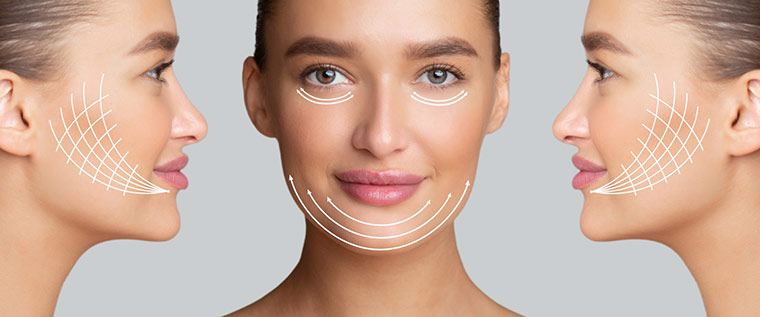
A deep plane facelift brings natural, long-term benefits.
From giving you a youthful look to increasing your confidence, a deep plane facelift can do wonders.
But what exactly is a deep plane facelift? How does it differ from other types of facelift? Is it better than standard facelift surgery?
In this article, I’ll answer all of the most common questions about deep plane facelift.
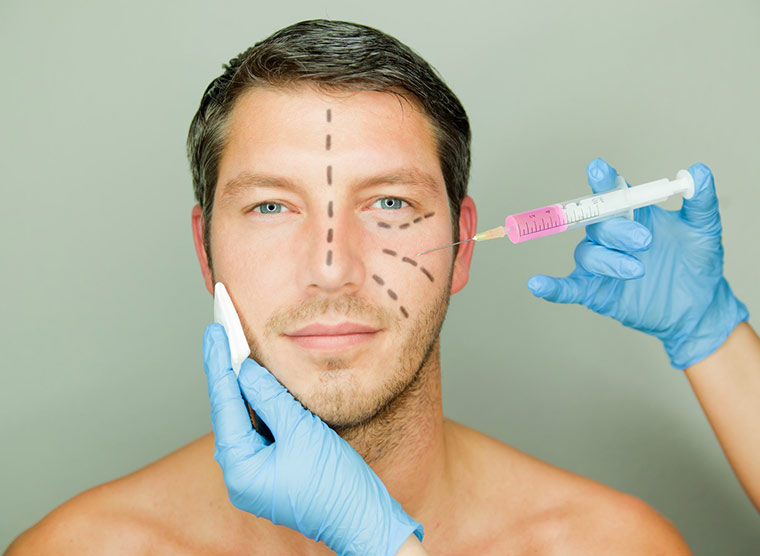
A deep plane facelift produces long-lasting, more natural, and more subtle results.
The deep plane describes the place that exists between the SMAS-platysma complex and the deep layer of muscles used for facial expression.
In case you’re wondering, the SMAS-platysma complex is composed of muscles and the fascia― the band of connective tissues beneath the skin. The fascia attaches, encloses, and stabilizes the muscles.
As its name implies, a deep plane facelift focuses on the face’s deep plane. The original concept was to operate beneath the supportive layer of the face, as opposed to just operating on the skin.
This method worked because facelift surgeons found out that when skin is pulled up, it ends up being tight. Since the skin is naturally elastic, operating on it produced results that didn’t last as long. Plus, the results can look unnatural with stretched lines in people with thinner skin.
Hence, operating on the deep plane can produce long-lasting, more natural, and more subtle results.
However, as promising as its results are, the deep plane facelift is the most advanced type of facelift. Due to its nature, less than 5% of plastic surgeons can do it.
I am proud to be part of this small percentage. I personally developed a signature deep plane facelift based on my extensive experience and research in facial anatomy & surgery.
My signature deep plane facelift incorporates the principles of a deep plane facelift and the Golden Ratio. It also involves special techniques to minimise pain.
In particular, the deep plane facelift leaves the skin attached to muscle layers, lifting only under the said muscle layers.
The procedure also lifts the cheeks by releasing the attached points of the face. This eliminates the need for additional filler or fat.
By doing these, my signature deep plane facelift produces more natural results compared to other surgical facelift types.
At the end of every procedure, my patients achieve sharper, subtle, and more natural looks.
My signature deep plane facelift is best for people aged 40 to 60. Ideal candidates are those suffering from significant fine lines, wrinkles, facial volume loss, sagging skin, and jowls. Recovery time can take up to two weeks.

Comparing deep plane facelift surgery with other types helps determine the best procedure for you.
The best facelift type varies from one person to another. Hence, it helps knowing the differences between my signature deep plane facelift and other types of facelift.
Surgeons used to do facelift procedures by operating on the skin only, making the skin-only facelift one of the most traditional types of facelift.
As its name implies, the skin-only facelift involves operating on the skin. It does not lift the tissue beneath it. On the other hand, the deep plane facelift involves operating under the supportive layer of the face.
The skin-only facelift produces instant results. Recovery time (1 to 2 weeks) is shorter than that of a deep plane facelift. However, the results of my signature deep plane facelift last longer than those of a skin-only facelift.
SMAS stands for superficial muscular aponeurotic system. Hence, the SMAS facelift targets the said area.
Just like the deep plane facelift, the SMAS facelift also targets the lower two-thirds of the face.
However, the primary difference is the SMAS facelift raises the skin and SMAS layer separately. The deep plane facelift raises them together.
Recovering from an SMAS facelift UK takes longer than recovering from a deep plane facelift. In particular, it takes 3 to 8 weeks. The results of my signature deep plane facelift also last longer than those of an SMAS facelift.
MACS stands for minimal access cranial suspension. A MACS facelift targets the underlying muscles of the face.
The deep plane facelift targets a larger area compared to a MACS facelift. Recovery time (3 to 4 weeks) is slightly longer compared to my signature deep plane facelift. The results of my signature deep plane facelift last longer as well.
A mini facelift is done by making tiny incisions on the face. Since the incisions are small, a mini facelift produces less dramatic results compared to my signature deep plane facelift.
In addition, a mini facelift only involves the skin. On the contrary, the deep plane facelift involves the skin and supportive layer of the face.
You can recover from a mini facelift (1 to 3 weeks) faster than a deep plane facelift. However, the results of my signature deep plane facelift last longer.
The S-lift involves S-shaped incisions and removing excess skin and fat.
Recovering from an S-lift (3 to 5 days) is shorter than recovering from a deep plane facelift. However, the results of my signature deep plane facelift last longer.
Here’s a table summarizing the main differences between deep plane facelift and other kinds of face lift plastic surgery.
| Recovery Time | Best Age | Risks | |
| Deep Plane Facelift | 2 to 3 weeks | 40’s to 60’s | Bruising, swelling, & bleeding |
| Skin-Only Facelift | 1 to 2 weeks | 30 to 40 | Unnatural lines in skin Bruising, swelling, & bleeding |
| SMAS Facelift | 3 to 8 weeks | 40’s to 60’s | Bruising, swelling, bleeding, & delayed wound healing |
| MACS Facelift | 3 to 4 weeks | Late 30’s to 60’s | Bruising, swelling, scarring, & bleeding |
| Mini Facelift | 1 to 3 weeks | Late 30’s to 40’s | Bruising, swelling, bleeding, & scarring |
| S-Lift | 3 to 5 days | Late 30’s to 60’s | Bruising, swelling, & bleeding |
Recovering from a deep plane facelift often involves bruising and swelling around the affected area for the first few days. However, they eventually disappear on their own.
Since my signature deep plane facelift is done on the supportive layer of the face, you’ll experience minimal bruising, swelling, and pain after the procedure.
In addition, my signature deep plane facelift doesn’t sever the blood vessels between the muscle and skin. Hence, you can heal quickly.
Facelift involving the SMAS can disrupt the blood vessels, and so bruising and swelling are greater in non-deep plane facelifts.
You might also be prescribed some pain medication to help you feel more comfortable during recovery. Applying cold compress, elevating your head while sleeping, and getting plenty of rest can also help you recover faster.
My signature deep plane facelift produces minimal to zero scarring. Since the deep plane facelift does not separate the skin from the muscles, there is no tension on the incision lines when closed. This makes the incisions less noticeable.
In addition, a deep plane facelift prevents pulling the earlobe, which can create a pixie ear. A pixie ear is a deformity in which the earlobes become elongated and pulled down after a face lift plastic surgery.

From producing natural results to boosting your confidence, a deep plane facelift has many benefits.
A deep plane facelift has many benefits. As one of the few surgeons who can do a deep plane facelift, I have developed special techniques you can benefit from.
Here are the benefits of a deep plane facelift.
1. A deep plane facelift produces natural and subtle results.
My signature deep plane facelift produces more natural and subtle results compared to other types of facelift. It’s because of the precise customised surgical techniques I use. These techniques are based on extensive research and experience.
In addition, a deep plane facelift does not just pull back the skin. Due to this, its results last longer compared to other types of facelift procedures. It can last up to a lifetime, without the need for additional fillers or fat.
2. A deep plane facelift reduces various signs of aging.
Our skin becomes less elastic as we age. Due to this, common signs of aging become more noticeable. Our wrinkles become deeper. Our skin sags more.
A deep plane facelift effectively reduces signs of aging such as sagging skin, jowls, nasolabial folds (lines from the edge of the nose to the mouth), and excess neck fat. After a deep plane facelift, you can expect smoother, younger-looking skin.
3. A deep plane facelift acts as prevention.
If your profession (e.g. acting, modeling) relies on your appearance, a deep plane facelift can help you fight signs of aging early.
In addition, getting a facelift early helps you recover faster. It’s because there’s less tissue repositioning done.
4. A deep plane facelift boosts your confidence.
Aging is a natural process. However, many people are worried about looking old and tired all the time.
This is where a deep plane facelift comes in. It gets rid of any worry you have about your looks. As a result, you become more confident and ready to take on the world.
5. A deep plane facelift is a permanent solution.
A deep plane facelift offers a more permanent solution compared to non-invasive facelift treatments. It can last up to a lifetime, without the need for fillers or non-surgical procedures.
In addition, a deep plane facelift saves you a lot of money in the long run. It’s because you don’t have to keep on getting treatments over decades.

A deep plane facelift’s results last longer and look more natural than those of standard facelift surgery.
In general, yes. A deep plane facelift is better than standard facelift surgery. For instance, if you’re wondering which is better―an SMAS or deep plane facelift ― surgeons will say it’s the latter.
It’s mainly because a deep plane facelift’s results last longer, look more natural, and appear more subtle than those of standard facelift surgery.
However, the best facelift varies from one person to another. A deep plane facelift may be the best for you, but not for another patient.
The best facelift depends on your age, genetics, skin condition, goals, and lifestyle. Consulting a doctor is a must to know the best facelift for you.
Deep plane facelift works best for patients aged 40 to 60. It is ideal for those who have significant signs of aging such as fine lines, wrinkles, sagging skin, facial volume loss, and jowls.
Candidates must also be in good health. During your consultation with me, we will discuss your medical history to see any possible complications. I will also determine if my signature deep plane facelift is the right procedure for you.
It mainly depends on the amount of tissue and skin to be dealt with.
To give you an idea, a deep plane facelift surgery can take 2 to 4 hours. The procedure can take longer if there are other treatments needed aside from the facelift.
I take as much time as needed to ensure the best results.
Each patient has unique needs and goals. Some need more adjustments, while others need fewer.
A deep plane facelift UK can cost £14,000 to £30,000.
It can increase depending on the additional treatments needed such as volume enhancement (fat transfer) and chin augmentation.
Please take note that a facelift is a complex procedure that requires many years of medical training and experience. Hence, it costs high.
However, a deep plane facelift is a one-time investment that lasts a lifetime.
A bandage is placed around your head. This supports your face and reduces swelling. We also use micro-drain for some patients to enhance recovery.
My patients can leave the clinic after 1 to 2 hours. Most patients experience little to no pain. However, strenuous activities like exercise must be avoided.
I also see my patients the day after the surgery to provide my contact details. I do this so anyone can contact me anytime.
In 5 to 7 days, your facial stitches will be removed. After 2 weeks, most of the swelling will be gone.
Here’s a facelift recovery photo journal of my patients.
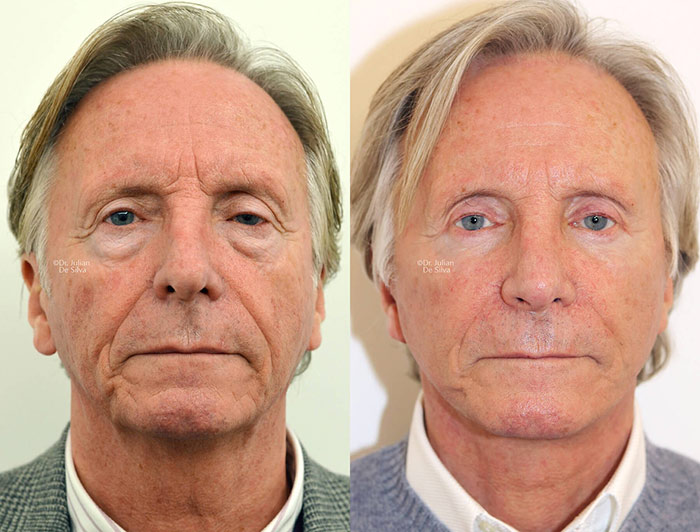
Patient Before and After 1: This patient suffered from deep nasolabial folds (smile lines), wrinkles, jowls, and significant sagging skin. Before coming to my clinic, his jaw and neck were uneven. His eyes look tired and uneven as well.
The patient had a facelift and necklift. The procedure included customised techniques that hid the scars in the natural curves around his ear, within the hair, and behind the ear.
After the surgery, the patient had a smoother jawline, an even neck, less nasolabial folds, eye bags, & wrinkling, and a younger-looking face. His eyes became more alive as well.
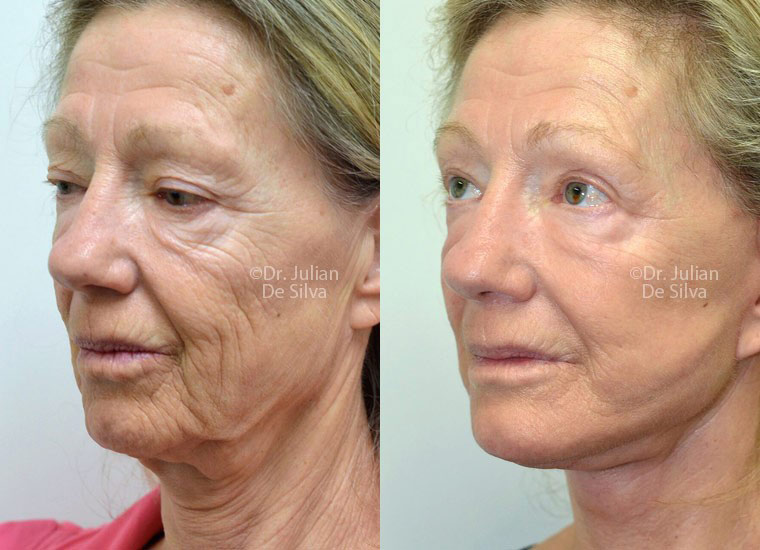
Patient Before and After 2: This patient suffered from significant sagging skin, wrinkles, deep nasolabial folds, and a turkey neck. Before coming to my clinic, her jaw was uneven, her skin sagged all over her face & neck, and her eyes looked tired.
The patient had a facelift and necklift with fat transfer. Micro-cannula neck liposuction to restore a more youthful jaw and neck angle was also done. The procedure included customised techniques that produced natural results, just like what the patient wanted.
After the surgery, the patient had a smoother jawline, an even neck, less wrinkling, better skin, and a younger-looking face.
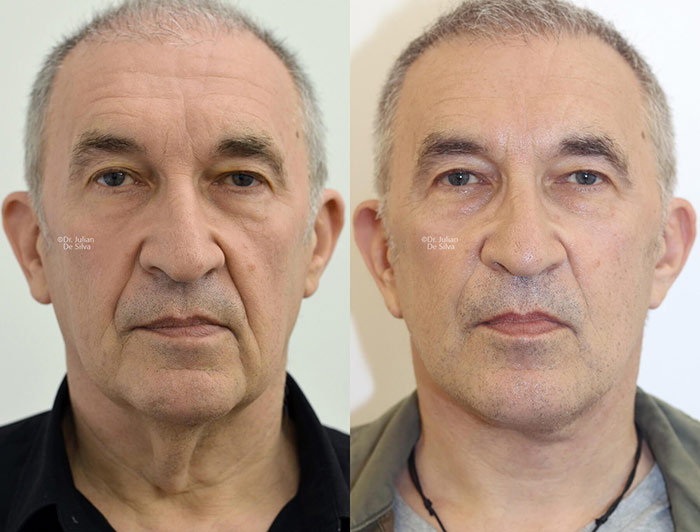
Patient Before and After 3: This patient suffered from wrinkles, sagging skin, deep jowls, and deep nasolabial folds (smile lines). Before coming to my clinic, he had a tired and uneven look with a turkey neck.
The patient had a facelift and necklift. The procedure included customised techniques that hid his scars in the natural curves around his ear, within the hair, and behind the ear.
After the surgery, the patient had a smoother jawline, an even neck, less noticeable nasolabial folds, and a younger-looking face.
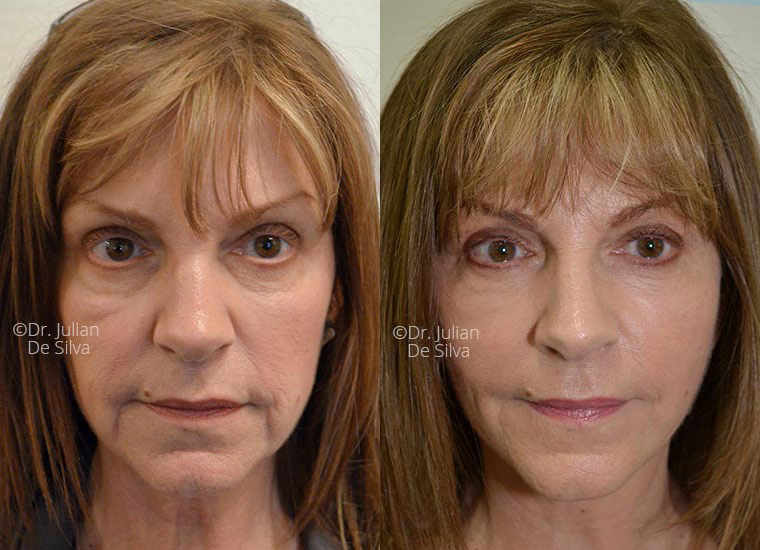
Patient Before and After 4: This patient suffered from wrinkles, sagging skin, noticeable jowls, and deep nasolabial folds (smile lines). Before coming to my clinic, she had a tired look with an uneven chin.
The patient had a facelift and necklift with fat transfer and laser resurfacing. The procedure included customised techniques that rejuvenated her face and eliminated her problems.
After the surgery, the patient had a smoother jawline, an even neck, a younger-looking face, and less visible jowls, wrinkles & nasolabial folds. Her skin became smoother as well.
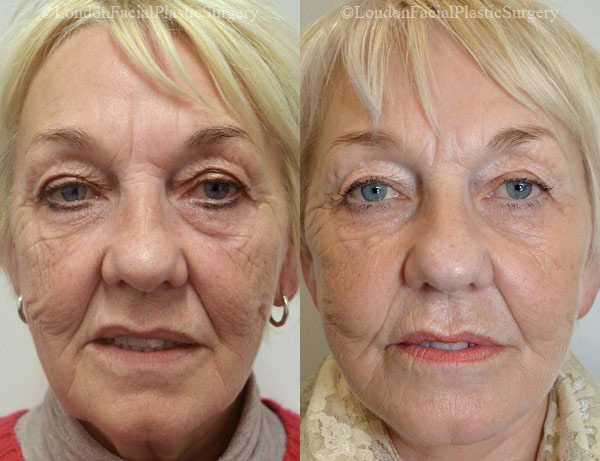
Patient Before and After 5: This patient suffered from sagging skin, especially around her face and neckline. Before coming to my clinic, her jaw was uneven. Her small chin exaggerated this appearance.
The patient had a facelift and necklift. The procedure included a triple-layered closure of the skin to avoid scarring and ensure long-term results.
After the surgery, the patient had a smoother jawline, sharp neck-jawline angle, and younger-looking face.
As seen above, a deep plane facelift can significantly change your appearance, without producing artificial results. All of my patients left deep plane facelift reviews stating how happy they are with the results.
While a deep plane facelift is better than other types of standard facelift surgeries, it might not be the best for you. To determine the best facelift for you, consult your doctor first.
Book a consultation with us now to know if a deep plane facelift is right for you!
Renowned expert in Facial Cosmetic and Plastic Surgery. Signature techniques in Blepharoplasty, Rhinoplasty and Facelift surgery. Expert in revision surgery and in natural looking results